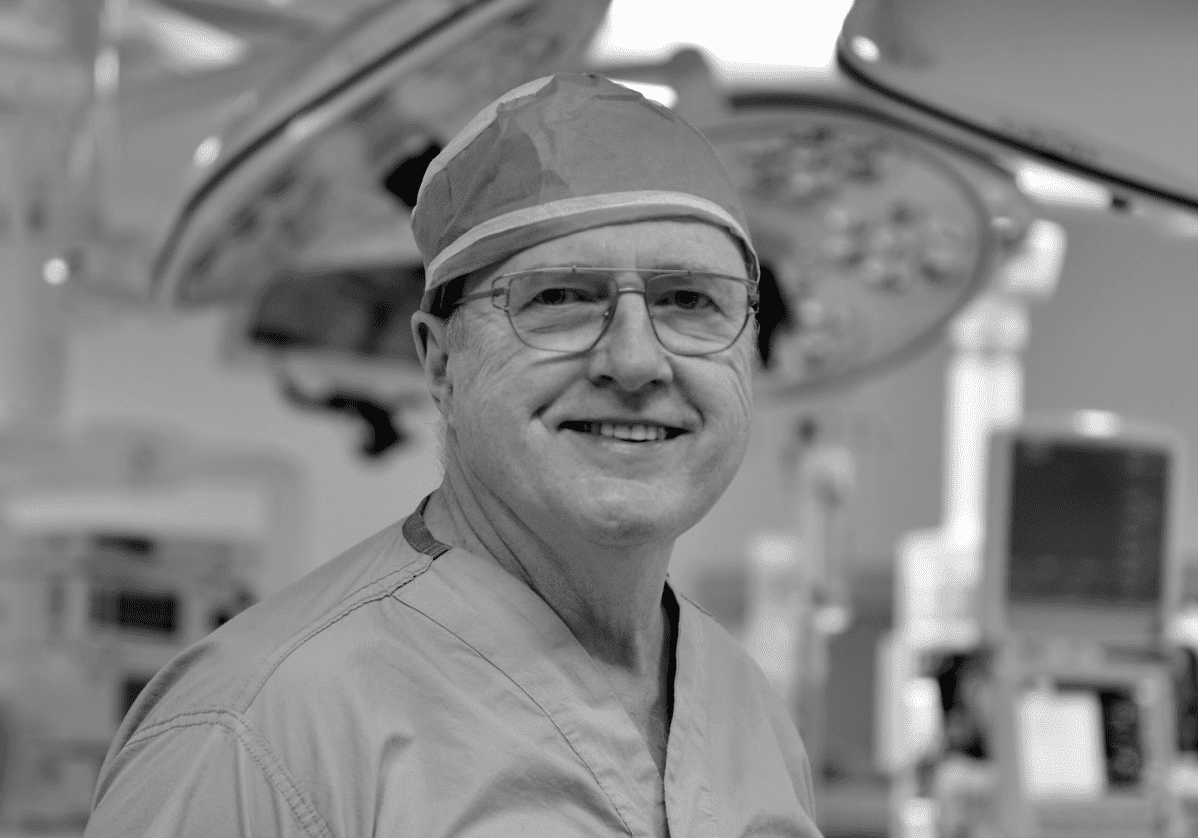

Garnette Sutherland is a world-renowned neurosurgeon, professor, and pioneer in medical technology. His innovations have been adopted in over 100 institutions across the globe. Dr. Sutherland successfully created an international collaborative network dedicated to improving patient care through safer, more precise surgical procedures, as reported by iedmonton.net.
Early Life and Inspiration
Garnette Roy Sutherland was born on August 30, 1952, in Edmonton. His father, Wilbert, joined the First Canadian Army at 19 and was sent to Europe in 1944. After the war, his family eventually moved to Calgary. The young man’s mother was a role model for him, instilling a strong work ethic.
Garnette was born eight weeks premature at a perinatal centre in Edmonton. He remained in the neonatal intensive care unit for a time while his mother returned to Calgary to look after his two older siblings. At 18, Garnette entered the Faculty of Science at the University of Manitoba. In high school, he excelled in science more than any other subject. Sutherland found his calling after visiting the Montreal Neurological Institute. The complexity of neurological problems and the capacity of surgery to help a large number of patients captivated him.
Education and Academic Career
In 1974, Garnette earned a Bachelor of Science degree, followed by a Doctor of Medicine degree in 1978, both from the University of Manitoba. He then moved on to complete his neurosurgery residency at the University of Western Ontario. While there, he published a paper on a novel imaging regimen for blunt chest trauma, which was recognized with a prestigious award from the American Trauma Society. This early experience inspired Garnette to use new technologies in the study of diseases.
Sutherland’s career path was heavily influenced by his training under the legendary Dr. Charles Drake, considered the best neurosurgeon in the world at the time. In 1984, Sutherland returned to the University of Manitoba as an Assistant Professor of Neurosurgery, earning a promotion to Associate Professor in 1988. At this institution, in addition to teaching and clinical practice, he established one of the first experimental laboratories of its kind to study neurological diseases using Magnetic Resonance Imaging (MRI) and spectroscopy. This led to a collaboration with the National Research Council (NRC) and the eventual creation of the Institute for Biodiagnostics in Winnipeg.
Integrating MRI Technology and the Calgary Stroke Program
One evening, a critically ill three-year-old girl with multiple brain tumours was rushed to Winnipeg for neurosurgical treatment. Garnette removed the tumours, but a post-operative CT scan showed he had missed two, requiring a second surgery. This moment led Sutherland and his colleagues at the National Research Council to discuss how revolutionary it would be if an MRI machine could be in the operating room, rather than just a research centre. This pivotal conversation launched the collaborative work to integrate Intra-operative MRI (iMRI) technology into the neurosurgical suite to eliminate the need for repeat operations.
In 1993, driven by this new energy, Garnette accepted the position of Professor and Head of Neurosurgery within the Department of Clinical Neurosciences at the University of Calgary. There, he successfully implemented several pioneering programs that further solidified the university’s international reputation and attracted the attention and support of esteemed Calgary figures.
Sutherland went on to champion the sole provincial program for stroke patients, encompassing prevention, acute care, and rehabilitation. The result was the Calgary Stroke Program, which is now world-renowned and has set global standards for stroke treatment, benefiting many Albertans. Garnette also anticipated the need for a team of experts to serve Alberta’s growing patient population. To attract and retain experienced neurosurgeons, he developed an alternative payment plan that was adopted by the Government of Alberta and later by many other Canadian provinces.
To solve the problem of repeat surgeries, Sutherland began the work to integrate MRI technology into the operating room, allowing surgeons to obtain detailed 3D images during the procedure. However, developing such a system required overcoming significant scientific, technological, and financial challenges. He launched a successful philanthropic fundraising effort within the Calgary community, which led to the birth of the Seaman Family MRI Research Centre. Garnette served as the centre’s director from 1997 to 2007. Over 90,000 neurosurgical patients worldwide, many of them Albertans, have benefited from the iMRI system he created. It allows surgeons to acquire detailed 3D images of the brain during operations, increasing the accuracy of tumour removal and improving patient outcomes.
Creating a Robotic System to Simplify Brain Surgery
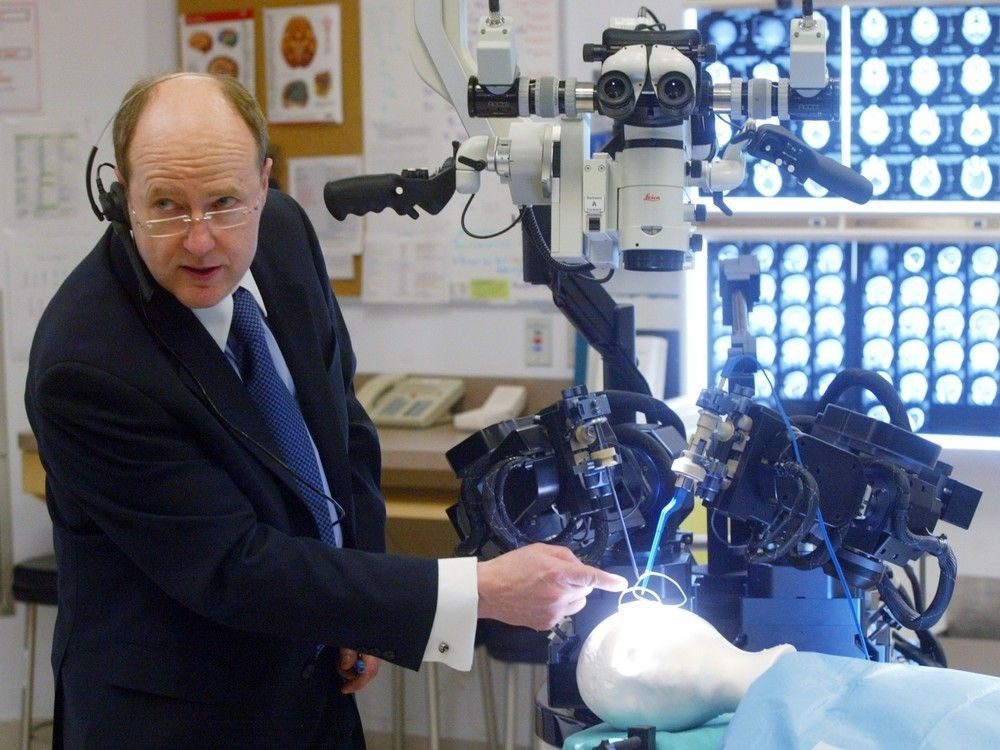
Building on his success, Sutherland soon developed NeuroArm—a system that allows neurosurgeons to control a robotic arm using joysticks and a foot pedal throughout the most complex stages of neurosurgical operations. Remarkably, the robot is capable of manipulating microscopic instruments and executing movements with a level of precision unattainable by the human hand.
On May 12, 2008, Garnette made innovation history by successfully using NeuroArm to remove a brain tumour from a 21-year-old Calgary resident. This pioneering technology, protected by several patents, was a unique achievement globally.
NeuroArm was developed in collaboration with the aerospace company Macdonald Dettwiler and Associates (MDA). Notably, NASA and the Canadian Space Agency consider NeuroArm a breakthrough innovation, enabling the application of space technology on Earth. In 2014, Garnette was inducted into the Space Technology Hall of Fame.
Awards and Ongoing Medical Practice

Sutherland’s success in innovation stems from his brilliant clinical experience and a unique, collaborative leadership style. His teams are consistently international and interdisciplinary. For instance, the NeuroArm group includes the Cumming School of Medicine at the University of Calgary, the Canadian Space Agency, and many others.
Garnette’s outstanding pioneering work and his contributions to science and medicine are reflected in over 370 publications, 33 monographs, and more than 22 patents. He has received numerous awards, prizes, and recognitions. In 2012, he was appointed a Member of the Order of Canada for his lifetime achievements in health innovation, and in 2019, Garnette received the Governor General’s Innovation Award for improving surgical outcomes through technology. He is also a recipient of the Queen Elizabeth II Diamond Jubilee Medal, the Queen Elizabeth II Platinum Jubilee Medal, and an Honorary Doctor of Science degree from the University of Western Ontario. NASA has also honoured Garnette twice.
Garnette Sutherland continues to treat a large number of patients with complex neurosurgical conditions, meeting with them personally to understand their issues and determine the best course of action. He remains proud that he has successfully integrated technology into medicine, making neurosurgical operations precise and effective.